
Strategic directions
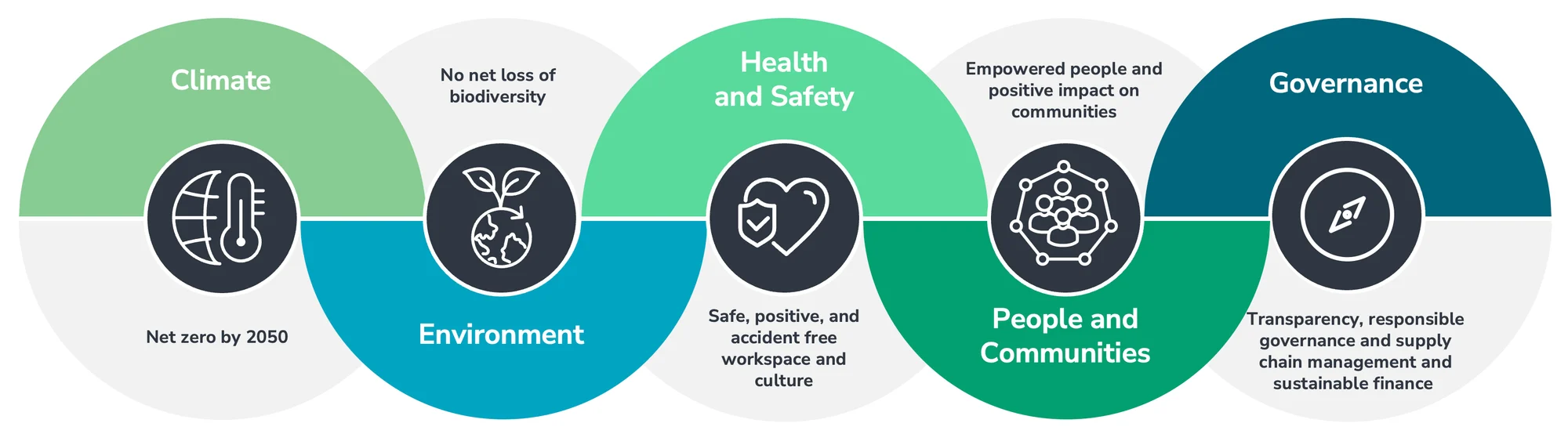
Climate
Climate change is one of the greatest challenges facing humanity in this century, making the actions of all stakeholders – governments, companies, non-governmental organisations and society – important. While energy is the driving force of the economy, its production accounts for a significant share of greenhouse gas (GHG) emissions. Therefore, transforming the energy sector and reducing GHG emissions are essential to achieving the goals of the Paris Agreement and limiting the increase in the global average temperature to 1.5°C above pre-industrial levels.
GHG emissions reduction
The group supports and endorses the global commitment to avoid the impacts of climate change and to make efforts to ensure that global warming does not exceed the 1.5˚C scenario set out in the Paris Agreement compared to pre-industrial levels. The group is committed to contributing to climate change mitigation and the sustainable development of the energy sector, taking into account the Paris Agreement and the National Energy Independence Strategy.
The group has set ambitious strategic targets for reducing GHG emissions at levels 1 and 2 – to reduce emissions by 30% by 2026 and by 50% by 2030 compared to 2019 levels. It is noted that these targets are also linked to the “EPSO-G” long-term sustainability-linked financing program (hereinafter – Financing Program) and the prospectus for sustainability-linked bonds. The Financing Program received an independent assessment from the international climate and environmental research center “CICERO Shades of Green”. In the provided independent assessment, the sustainability goals set out in the “EPSO-G” Financing Program are identified as ambitious compared to the sustainability goals set by other similar companies operating in Europe. These goals are also established as largely responsive to the objectives set out in the Paris Agreement related to reducing the impact of climate change.
| Target | Base year and value | Progress towards targets | Reduction target | Status | |||
|---|---|---|---|---|---|---|---|
2019 | 2025 | 2024 | 2023 | 2026 | 2023 | ||
Scope 1 and 2 GHG emissions, tCO₂e | 205 397 | 177 588 | 217 941 | 258 989 | 143 789 | 102 707 | Target in progress |
Change in Scope 1 and 2 GHG emissions | - | -14 | 6,1 | 26,1 | -30 | -50 | Target in progress |
Bond issuance
In June 2022, EPSO-G issued a sustainability-linked bond, raising EUR 75 million. This was the first sustainability-linked bond issuance in the Baltic States. The five-year bonds, with a yield of 3.117%, were acquired by institutional investors from Lithuania, Latvia, Estonia and Sweden. The European Bank for Reconstruction and Development purchased almost one-third of the issue, amounting to EUR 22.5 million.
EPSO-G UAB undertakes that the funds raised under the Long-Term Financing Programme will not be used for investments in the expansion or modernisation of the natural gas transmission network. Part of the bond proceeds (EUR 22.5 million) will be used to reconstruct the 330 kV overhead line Šiauliai–Tytuvėnai and the 330 kV overhead line Tytuvėnai–Kaunas. Once the reconstruction is completed, the transmission capacity of the lines will increase by approximately 20%.
The Long-Term Financing Programme set out the Group’s long-term sustainability targets. The first target is to reduce Scope 1 and 2 greenhouse gas emissions generated by the Group companies’ operations by 50% by 2030, using the market-based method and compared with the 2019 baseline. The second target relates to the reliability of the electricity transmission network – to ensure the lowest possible amount of energy not supplied, with the indicator not exceeding 136.255 MWh during the 2022–2026 period.
Climate risk
We conducted a comprehensive assessment of climate change risks and opportunities to evaluate the resilience of the Group’s strategy and business model to climate change and identify opportunities to strengthen adaptation.
To better understand the likelihood of climate-related risks materialising, we conducted the analysis over the short term (up to 2026), medium term (up to 2030) and long term (up to 2050), in accordance with international climate risk assessment practices. The assessment considered two socio-economic development scenarios developed by the Intergovernmental Panel on Climate Change (IPCC): a scenario aligned with the Paris Agreement, limiting the increase in average global temperature to 1.5/2°C (SSP1–2.6), and a business-as-usual scenario under which the average global temperature could increase by more than 4°C (SSP5–8.5).
The assessment results show that physical risks will have a relatively limited impact on the Group’s activities in the short, medium and long term, except for potentially greater impacts in the event of flooding and extreme fluctuations in water levels.
The impact of transition risks at Group level is also assessed as relatively limited, although it varies at the level of individual companies. More detailed information on the Climate Change Risk Assessment is provided in the file below.

Enviroment
In operating and expanding energy system infrastructure, we seek to minimise our environmental impact. At the project planning stage, we conduct environmental impact assessments to identify potential environmental impacts in advance and determine the necessary measures to avoid, mitigate, compensate for or restore such impacts. We monitor the environmental impact of our activities and, based on the results, implement appropriate management measures.
Biodiversity
We have integrated biodiversity and ecosystem protection into the Group’s strategy. In implementing new projects, we are committed to achieving No Net Loss of Biodiversity. To systematically and consistently manage potential negative impacts, we plan to prepare a comprehensive analysis of the Group’s impact on biodiversity and ecosystems and an action plan, including a more detailed assessment of the resilience of our business model and strategy.
Circular economy
The Group’s strategy prioritises the use of circular procurement practices. The rational use of resources and the implementation of circular economy principles are important areas of our sustainability efforts; however, the Group currently does not have an operating model for integrating circularity principles at Group level. Going forward, we plan to strengthen this area by defining more detailed objectives and implementation measures.
People and communities
People are one of the key factors in implementing the EPSO-G Group’s strategy. We create a safe, inclusive and growth-oriented working environment, strengthen leadership, and develop employee competencies and talent. We continuously assess employee experience and engagement and use the insights gained to improve our organisational culture, working environment and people management practices.
As we implement large-scale infrastructure projects, we maintain ongoing engagement with local communities.
Employee safety and health
The Group’s strategy sets the direction to create a safe and positive working environment and strengthen the safety culture. We have set a target of zero serious and fatal accidents involving both employees and contractors.
We systematically engage employees in dialogue on work-related impacts on their health and safety, providing opportunities to express their views, make suggestions, participate in occupational risk assessments and contribute to decision-making on improving working conditions.
Diversity and inclusion
We aim to ensure that our people feel respected, valued and able to fully realise their potential. We create an environment where diverse experiences and perspectives contribute to better decision-making, foster collaboration and strengthen organisational resilience.
We integrate the principles of diversity, equal opportunities and inclusion into employee recruitment, development, leadership, employee engagement assessments and internal communication. We develop the competencies of managers and employees, improve internal policies and processes, assess progress and cooperate with organisations promoting inclusion.
We assess progress based on data on workforce composition, employee engagement and experiences of inclusion. This helps us make informed decisions and systematically strengthen an open, respectful and inclusive workplace culture.
The EPSO-G Group is a member of the Lithuanian Diversity Charter Association. This membership strengthens our commitment to creating an open and inclusive working environment and cooperating with organisations working to advance diversity and equal opportunities.
Communities
We have established a strategic direction to create a positive impact on communities.
In carrying out our activities, we take into account the interests and views of communities, prioritising open communication and cooperation. We seek to ensure proactive and continuous dialogue, timely responses to enquiries and high-quality information provision both when planning activities that may affect communities and during their implementation.
We inform communities in advance about infrastructure projects planned and being implemented by Group companies in their neighbourhoods. During project implementation, we coordinate the timing of works with residents, seek to minimise any inconvenience caused by the works, address such inconvenience and respond to residents’ questions.
Currently, we:
engage with communities in accordance with good practice by organising information meetings, providing information in writing and through the media, and maintaining dialogue with community representatives, elderships and municipalities;
assess potential impacts on communities during the planning of projects and implement preventive and impact mitigation measures;
monitor the dynamics of community-related issues through complaints, enquiries and dialogue channels, thereby assessing the effectiveness of the measures applied.
Governance
Our governance is based on the Group’s values and Code of Ethics, which sets out the key standards and principles of conduct.
We have established standards of conduct that we expect all our partners to follow. In this way, we promote lawful, professional, sustainable and fair business practices encompassing environmental, human rights, labour standards and business ethics principles.
Sustainable supply chain
The Group’s strategy sets the direction of ensuring a sustainable supply chain. This direction includes implementing sustainable and responsible business practices and actively cooperating with business partners to achieve common sustainability goals.
We are committed to:
by 2035, transitioning to circular procurement, i.e. integrating circularity principles into the procurement process, including assessing the life cycle costs of purchased goods, services and works and applying other established circularity criteria;
by 2035, ensuring that at least 50% of partners have GHG emission reduction plans.
Partners' code of ethics
“EPSO-G” group companies are responsible for the smooth implementation of strategically significant energy projects for the Lithuanian state, following the highest standards of environmental protection, business ethics, transparency, and employee health and safety. In order to achieve greater progress in sustainability, the “EPSO-G” group encourages all its partners not only to comply with the law but also to adhere to the principles set out in the “EPSO-G” group Partners’ code of ethics, which will serve as the basis for constructive cooperation.